I am glad that you are taking your time out to read this. I have been thinking of blogging for very long time now. Now I have started my first step. I hope you all will enjoy my upcoming blogs.
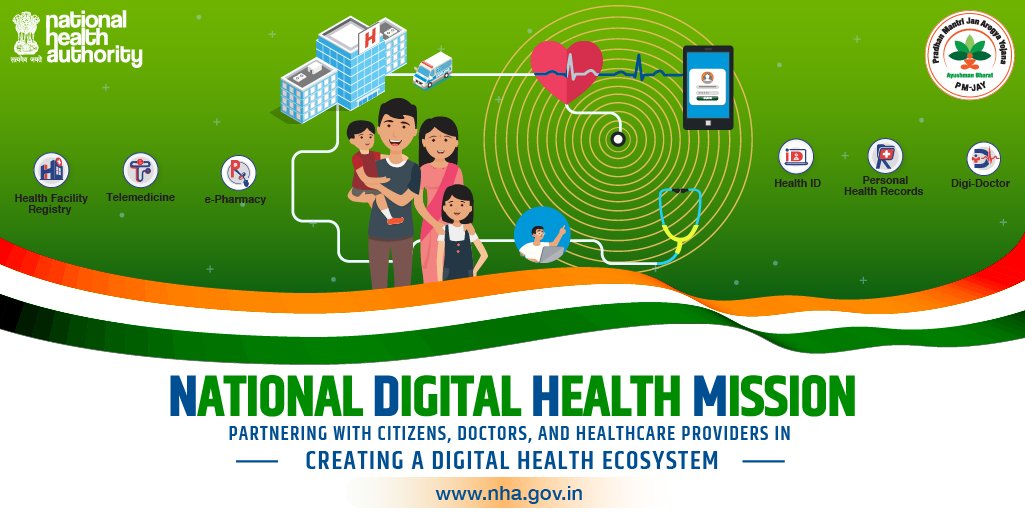
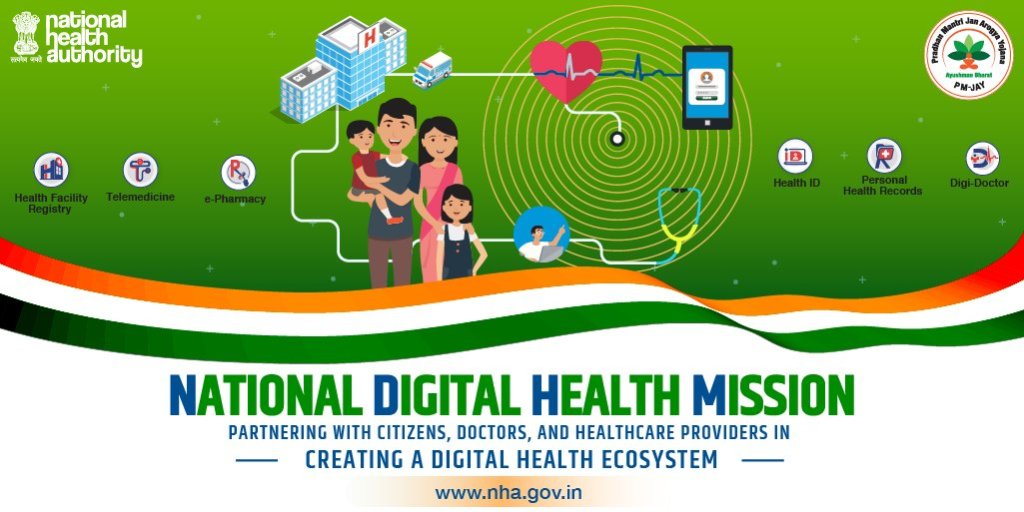
National Digital Health Mission (NDHM), a part of Ayushman Bharat Pradhan Mantri Jan Arogya Yojana (AB PM-JAY), was launched by the Prime Minister Narendra Modi on India’s 74th Independence day in August, 2019. The initiative is completely technology based intended to improve the health services in India. Under the scheme, a Health ID will be provided to the patient which will contain his/her medical information such as the name of the health problem, diagnosis, name of the medical practitioner, medicines prescribed, medical history or a complete health analysis of the patient, etc. The scheme is supposed to bring about efficiency and transparency in the medical sector. Each time a patient goes to the doctor or to a pharmacy, he/she will have to provide his Health ID which will have all the concerned information. For the sake of confidentiality, a one-time access will be given to a doctor or a pharmacy while medical check-up is done or medicines are bought respectively. But however, some privacy concerns have been raised against the policy. Although the consent mechanism is there, but the question is still there. Is our medical data safe when we consent for digitising and storing our medical data or giving its access to doctors and pharmacy holders?
The Structure of the Scheme
As of now, the scheme has four digital health systems to store and access electronic medical records (EMR). The first one is Health Id. It will be given to the patients containing all their relevant medical information. It is the primary source to access such information or to prescribe or buy medicines. The second one is Digi Doctor. It is a kind of database which contains the details of the doctors enrolled in India. It will include their names, qualifications, specialization, years of experience, medical institution they are concerned with, registration number etc. The third one is Health Facility Registry (HFR). All medical health facilities will be registered in it and will contain all the other details like specialties, services provided, technology used etc. the fourth system is Personal Health Records (PHR). This system contains the medical information of the patients including their medical problem, diagnosis, medicines prescribed, medical history etc.
How Does it Work?
The National Health Policy of 2017 proposed National Digital Health Authority which in turn came with National Digital Health Blueprint in 2019. The later lead to National Digital Health Mission. Under the Mission, a Health Id will be given to the patients (data principals). It will be an app storing all their relevant health information. It will be linked to Digi Doctor and Health Facility Registry (HFR). The Consent Manager will take the consent from the data principal or patient to allow the flow of this information between systems. The Health Id will be in the form of mobile application created on the basis of person’s basic details, mobile and Aadhaar Number. The data principals have been given the access and decision-making powers over their data. They can register it, change it or delete it.
On entering hospital, the patient will scan the Health ID QR Code at the desk from his mobile app and hospital will immediately get all his medical details. The hospital will send a consent request to patient and till what time, such consent be given. The patient will choose what data to share and for how long should hospital have the access to such data. The doctors registered on the Digi Doctor will get the required details for the patient check-up. And patient will be accordingly referred to the said doctor who will require access to relevant medical data from the patient there as well. The medicines will be prescribed online and the details will be updated. The patient will have to again scan the Health ID QR Code at pharmacy to buy the prescribes medicines. The Health Facility Registry (HFR) will provide the names of the hospitals, dispensaries, clinics, labs and other health facilities across country for the convenience of citizens.
The NDHM is intended to digitize and improve the efficiency and transparency of health system in India to make it more accessible, convenient and citizen-centric. The patients will have remote access to their medical information, the private and public health facilities, consult medical professionals and receive better healthcare. Various concerns have been raised in relation to the Scheme such as privacy concerns, illiteracy, unavailability of mobile phones and that the Scheme will mostly benefit the urban population.
Privacy Concerns
The Scheme has raised various issues such as privacy and logistical concerns, portability concerns, concerns of medical and local communities etc. Among all of these, privacy concerns are the one to be primarily looked at. The Mission seeks to build a collaboration between govt. and private sector hospitals and other health facilities; hence the health data is vulnerable to commercial misuse and hacking. Although, the NDHM Data Management Policy contains provision for the anonymization of data. But the reports have shown that even after such anonymization of personal data, there has been results of targeted ads and insurance calls. In December (2017), the Maharashtra govt. reported the leakage of electronic medical records of some 35,000 patients from a lab because of unavailability of adequate protection measures. Sections 43 and 72 of the Information Technology Act provides for the protection of sensitive personal information. The section provides various procedures and standards to be followed. But §43 apply to only corporate bodies. While in NDHM, the data fiduciaries and data processors of medical data can also be public bodies. They can hence dispense with such provisions.
India doesn’t have any concrete law on privacy protection. Electronic Health Record Standards of Union Health Ministry are currently governing the electronic medical information. But the standards are flawed posing high risk of leakage of such information. The NDHM Data Management Policy doesn’t specify the exact procedure as to how they will own, store and process the medical information. The timelines to hold such information aren’t clearly defined. There is no mention of whether the patient can later made them to delete his/her medical data. There is a possibility of commercialization and selling of such data if proper safeguards are not followed. There are also chances of profiteering and foreign surveillance. When a huge amount of medical information is stored digitally in a central database, there are chances of leakage and data theft as we saw in Aadhaar. The leakage of such medical data can have serious socio-economic consequences such as social boycott of HIV patients etc. Two-third of the Indian population lives in rural areas. To avail the benefits of this Scheme, they don’t possess the necessary requirements such as smartphones, proper internet and mobile network, technology equipped health facilities, proper education to access digital information etc. The Scheme will hence only benefit the urban population. There is also a possibility of making the scheme mandatory which will hence exclude the major population having no access to aforesaid facilities. Although the medical data received will be deidentified and anonymized, but it can easily be reversed by comparing the data with voter Id and other details by the commercial agencies. Like Arogya Setu App, the data stored in NDHM App will be unsafe and vulnerable to hacking and misuse which will result into spam insurance and marketing calls, targeted aids etc.
The NDHM Health Data Management Policy stated that Aadhaar or any other document has to be used at the time of Health ID registration. But the Supreme Court has already limited the usage of Aadhaar and people are likely to use Aadhaar as their primary identity to be linked with Health ID. This makes the exercise very arbitrary. The Draft Policy is silent about the Consent Managers. Whether they will be private agencies or public ones; or digital systems, the policy doesn’t mention.
Conclusion
Although the Mission is very helpful and would make the medical system more efficient and transparent. But at the same time, its threats can’t be ignored. The Policy has raised various questions. With no concrete personal data protection legislation, the policy doesn’t talk about owning, storage and processing of data. It doesn’t talk about misuse, data theft, data leakage, penalties and remedies, etc. The Scheme works well on the paper. But it has unimaginable repercussions in reality.
Happy employees ensure happy customers. And happy customers ensure happy shareholders-in that order.
Simon Sinek
INTRODUCTION
Shareholder is a person who owns some shares in the company. By virtue of which, he becomes the owner of such company to that extent. And by virtue of which, he enjoys certain rights as a shareholder. The shareholders, subject to share capital, can be either equity shareholders or preference shareholders. The rights and duties of them vary accordingly. As per §47 of Companies Act, equity shareholders always have the right to vote in the appointment of directors and in passing of other company resolutions. While preference shareholders can vote only in certain situations. There are other rights which shareholders (equity ones mostly) enjoy. These rights include appointment of directors and auditors, right to receive dividend, right to transfer ownership by selling shares, make proposals, dissent and right to recall and attend general body meetings, right to information and inspect company registers, books and financial statements, right to sue directors for their wrongful activities etc. Being the owners of the company to the extent of their shares, the shareholders involve in fundamental activities and changes of the company. They indirectly govern the company and administer its business activities through Directors appointed by them.
SHAREHOLDERS IN INDIA
The Companies Act, 2013 doesn’t specifically define the ‘shareholders’ as such. However, as per Section 41 of the Act, the members can be categorized into three classes; members who subscribe to MOA of the company when it is formed, those who agree to company’s policy and whose name is registered by ROC, and those holding equity shares in the company and whose names are registered in the depository as a beneficial owner. As per the general view, a shareholder or stockholder is the person who subscribes or buys minimum of one share in the company. And he accordingly becomes the owner of the company to the extent of such purchase. More shares he purchases, the greater ownership he will possess.
Subject to the MOA and AOA of the company, any person can become a shareholder in a company by purchasing the shares and person includes both natural as well as artificial entities. It means that a company can also become a shareholder by purchasing the shares in a particular company. Subscribing to the shares of a company leads to a contractual relationship between company and the shareholder. Hence, any person competent to enter into contract under Indian Contract Act, 1872 can become a shareholder. It can be a company, an association, an institution or an individual.
Shareholders are of two types; equity or ordinary shareholders and preferential shareholders. Equity shareholders are the most prevalent type seen. As per §47 of Companies Act, equity shareholders always have the right to vote in the appointment of directors and in passing of other company resolutions. While preference shareholders can vote only in respect of the resolutions concerning them. Unlike equity shareholders, the dividend of preferential shareholders is fixed and is given to them even if company makes no profits. Equity shareholders are paid at last when dividend is divided or when company is wound up. While preferential shareholders are paid first. Apart from this, shareholders (equity ones mostly), by virtue of their position, enjoy various rights such as appointment of directors and auditors, right to receive dividend, right to transfer ownership by selling shares, make proposals, dissent and right to recall and attend general body meetings, right to information and inspect company registers, books and financial statements, right to sue directors for their wrongful activities etc. Shareholders and Board of Directors are the two important pillars of a company as far the company’s business is concerned. They fundamentally run the company. Being the owners of the company to the extent of their shares, the shareholders involve in fundamental activities and changes of the company. They indirectly govern the company and administer its business activities through Directors appointed by them
TYPES AND RIGHTS OF SHAREHOLDERS UNDER THE COMPANIES ACT, 2013
Shareholders are the owners of certain rights and interests in the company. These rights and interest are permanent and are measured in terms of money. It is a ‘chose in action’ type of interest or property which one is not having immediate possession of but has the right to it which can enforced by legal action.
Types of Shareholders
On the basis of types of shares bought or held, the shareholders are of two types; equity (common or ordinary) shareholders and preferential shareholders.
i: Equity Shareholders
They are also called as common or ordinary shareholders. They are most widely seen in corporate businesses. According to §43 of the Companies Act 2013, company’s share capital can be either equity share capital or preference share capital and the people subscribing to equity share capital are called as equity shareholders. They have voting rights and differential rights. The dividend is not fixed and depends upon the profits company makes. They are the last paid off at the time of dividend, or repayment of capital or at winding up. It is a risky but highly profitable source of investment. Through voting rights, the equity shareholders have a control over management of the company as they choose the Board of Directors through voting. Equity Shareholders can sell their shares to only to other buyers in the stock market but not to their own company. If their own company wants to buy them, they have to make a public offer to buy back such shares. E.g., Infosys
ii: Preferential Shareholders
The people subscribing to preference share capital are called as preferential shareholders. As per §43, they have to be given the preference at the time of distributing dividend and repayment (of capital or at the time of winding up). Preferential Shareholders have voting rights only with respect to the resolutions concerning them. The amount of dividend or profit is fixed and given to them even if company makes no profits. It is a profitable and safe source of investment. Section 47 says that if dividend fixed is not paid to them consecutively for two years, they acquire a position to vote in all resolutions. Preference shares are not traded in the stock market. Hence, their prices don’t vary usually. After certain time, preference shareholders can sell back their shares to the company.
Rights of Shareholders
By virtue of purchasing shares in the company and subsequent ownership to such ownership, the shareholders enjoy the following rights under The Companies Act, 2013. These rights were comprehensively discussed by Supreme Court in the case of Life Insurance Cooperation of India V. Escorts Ltd.
i: Right to Vote
Section 47 of the Act states that every equity shareholder has a right to vote in the resolutions passes by the company. It is also mentioned in the §43(a)(i) ad (ii) of the Act. however, the voting rights given to them are in proportion to the shares they have paid up for in the company. While as preference shareholders have the right to vote only in the resolutions concerning them. It also includes the resolutions for winding up or for repayment or reduction of equity or preference share capital of the company. They receive the fixed dividend which if not given to them consecutively for two years or more, they acquire a right to vote in all the resolutions of the company. Equity shareholders can appoint directors through voting and other institutions and individuals such as subsequent auditors in AGM. However, Section 106 of the Act says that company through its AOA can restrict voting rights of shareholders in certain cases such as unpaid shares and shares on which the company exercises right to lien. The section further states that voting rights can’t be restricted on any other ground. The vote can be made by showing hand, through proxy or through electronic means, by polling or through postal ballot.
ii: Right to Receive Dividends
Every shareholder whether equity or preferential, has a right to receive dividends at the end of the year according to the number of shares they hold in the particular company. Equity shareholders have also the right to receive interim dividend if declared by the Board of Directors. The dividends for equity shareholders are not fixed and depends upon the company’s business. While for preferential shareholders, the amount of dividend is fixed and given to them even if company makes no profits. The preference shareholders are preferred first over the equity ones, when the dividend is distributed or repayment during liquidation. A declaration for distribution of dividends is made by the Board with the authority of shareholders. Once such declaration is made, it creates a statutory debt against company in favour of shareholders. Shareholders’ right in the profits of the company exists irrespective of such declaration and they can claim such right by questioning Board in case no declaration is made despite company making profits.
iii: Right to Participate in General Meetings
According to Section 96 of the Companies Act 2013, the company is required to convene annual general meetings. The shareholders have the right to call for and attend general meetings of the company. They also have a right to approach Company Law Board as to how general body meetings will be conducted. The shareholders can also ask for extraordinary general meetings via board. It has to be convened by board within 21days and if it failed to do so after expiry of 45 days, the shareholders acquire right to convene it by themselves. All shareholders have the right to receive notice of annual general meetings, extraordinary general meetings, participate and vote in such meetings.
iv: Right to Transfer of Shares or Securities or other Interests
Section 44 of the Act states that the shares or debentures of a holder in the company are movable property and can be transferred through a process given by the AOA of the company. Sometimes, restrictions can be there upon such transfers and transmissions. Section 56 provides for such transfers and transmissions of shares and other interests between living shareholders and from deceased to successor/administrator respectively. While Section 58 provides for restriction upon such transfers which can be put by private company through its AOA or through pre-emptive clauses. There can also be private agreements between shareholders not there in AOA of the company. Such private agreements restricting transfers doesn’t bind the company though. However, such contracts or agreements are enforceable by members. Directors have the discretion to restrict the transfer of shares by shareholders. Such discretion is subjected to judicial and quasi-judicial interference in case it is mala fide or no adequate reasons are given or irrelevant considerations are provided.
v: Right to Initiate Legal Proceedings or Appeal to Tribunal
Although shareholders have to accept the decision made through majority voting. However, he has certain rights still with him. His right to receive dividend is an inherent right there irrespective of whether dividends are declared or not. If declaration is made but dividend is still not distributed. He has right to initiate legal suit. If the transfer or transmission is made by shareholders under §56 of the Act and it is not registered by the company, shareholders have the right to approach Tribunal with an appeal. Although an ordinary resolution is enough to appoint directors or remove them in certain situations. However, if it didn’t suffice, then the shareholders can commence legal actions under the Act. It includes fraud, mala fide acts, diversion of funds and assets of company; and other illegal and ultra vires acts which are prejudicial against the company affairs. They can also challenge resolutions before Tribunal on the grounds of mismanagement and oppression. A class action can also be filed by the concerned group of depositors or shareholders in situations mentioned under §245.
vi: Right to Information and Inspection.
Shareholders are the important structures of company. They have interests in the company in the form of their shares. Hence it is important to have all the financial and other fundamental information with respect to company’s business and management. They can ask questions to the Board where decisions are taken and inspect registers and account books of the company. Such as in the case of company making declaration of dividend with no subsequent distribution or no declaration at all. Section 129 provides that financial statements of the company has to be presented in AGM so that shareholders know the financial position of the company. The copies of financial statement and audited financial statement have to be given to them. have to be given to the shareholders. It is the duty of the company to send such statements to its shareholders. They have the right to know company general and monetary records and data, ask questions, require clarifications and can also challenge decisions. Section 119 provides right to the shareholders to inspect minutes of the meetings held which if refused, member can approach the Tribunal.
vii: Right to Proxy
Section 105 states that any person who is entitled to participate and vote in the meeting can also appoint a proxy who can do the same on his behalf in the meeting. However, there are certain restrictions. The proxy can only vote and speak in polling and he is not to be counted in quorum. Subject to the AOA of a company, proxies can not be appointed in companies without share capital. This right is important for the convenience of holders who due to absence or residing away from the company, can’t attend the meeting.
viii: Right to Alteration of MOA and AOA
Section 13 provides that MOA can be altered by passing a special resolution to that effect. The special resolution is passed where 75% of the shareholders who agree to such alteration. MOA is the fundamental and structural document of the company which defines the possible scope and management of the company and its operations. Similarly, Section 14 says that the AOA can only be altered by passing a special resolution signed by 75% of the shareholders. hence, shareholders play a significant role by possessing the right to amend memorandum and articles of the company.
ix: Right to Apply for Winding Up of Company
The shareholders have the right to apply for the winding up of company. Section 371 of the Act provides that a special resolution can be passed by the shareholders and apply to Tribunal to wind up the company. In the case of Chiranjit Lal Chowdhuri v Union of India, the Supreme Court held that shareholder has an interest in the company. It is a movable property which he can transfer, mortgage, pledge and sold. It gives him right to vote and hence involves indirectly in the company management. If these rights are refused to him, he can along with majority of shareholders institute action for winding up of company. Shareholders have to be informed of winding up.
x: Rights Issue
Under Section 62(1)(a) of the Act, the shareholders have the right to buy the shares when company decided to further issue or increase the subscribed share capital. They are to be issues to equity shareholders according to their held paid-up share capital. Hence, existing shareholders have a pre-emptive right when company further issues its shares.
xi: Right to Receive Share in Surplus Assets
When the company is wound up, shareholders have the right to get the shares in the surplus assets of the company at that time. The right is guaranteed by Section 297 of the Act and casts responsibility upon the Tribunal to distribute such surplus assets.
xii: Other Rights of Shareholders:
Make written recommendations to improve corporate governance in their company.
Make proposals to Board for improvements and other investment projects etc.
Right to be employed by their company and can act in dual capacity.
To ensure there is no competition from other shareholders against company.
Right to be named in the register and tagged in sales etc.
SHAREHOLDERS’ RIGHTS IN INDIA AND UK: COMPARATIVE ANALYSIS
In India, the shareholders enjoy multiple rights both statutorily and otherwise. These rights are given by The Companies Act of 2013. They have been termed as fundamental rights of shareholders by the Supreme Court in multiple cases. In UK, the Companies Act of 2006 along with other secondary legislations govern the corporate businesses. It was the Company Act of 1866 which was enacted in British India. This led to India Company Act of 1956. Hence, there are various similarities between the Indian Companies Act (2013) and UK Companies Act (2006). However, there is no single statement when it comes shareholders’ rights. However, some general statutory rights are seen everywhere. The English Companies Act of 2006 subjected to the AOA, provides some additional rights when compared to the Indian Companies Act of 2013. Furthermore, the Draft Shareholder Rights Directive adopted by the UK government provides various other rights to the shareholders without affecting the existing ones in the Companies Act, 2006.
Rights of Shareholders in UK
The shareholders in UK also called as members, enjoy various rights. Such as right to dividend, right to information and inspection, voting rights and appointments rights in case of directors and auditors, right to appoint proxy, right to request Board to convene meetings, right to receive notice of general meetings, right to initiate proceedings, right to winding up of company etc. The abovementioned additional rights include:
Right of the shareholders to be treated equally.
Rights to get published the votes casted in resolutions, on company’s website.
Right to block a special or an ordinary resolution.
Right to approve long term service contracts of Directors, substantial property and credit transactions, loans and quasi-loans, etc.
Right to receive a prior notice of 30 days for general meetings.
Right of joint shareholders to appoint a proxy with voting rights.
Right to derivative claims.
Right of shareholders to raise audit concerns in the general meetings and get them published on the official website of the company.
Compared to Indian Companies Act, the UK Act is very comprehensive and exhaustive company law legislation. The shareholders rights given in Indian Companies Act (2013) are all there in the UK Companies Act, 2006. The later provides certain additional rights mentioned above such as right to equal treatment, right to block resolutions, right to get votes and audit concerns published on the company’s website etc.
Shareholders facing Unequal Treatment
Whether general shareholders or the minority ones, the Indian shareholders face unequal treatment when it comes to involvement and participation in the company business. The concern has also been raised by the World Bank itself in the report on Corporate Governance Assessment. It stated that it doesn’t provide adequate rights and protection to its minority shareholders which has impacted the Indian economy. The dominant and majority shareholders have much greater say in the appointment of directors. The independent directors which were supposed to bring that gap aren’t that neutral. The auditors need to be independent and the process of auditing must be qualitative and transparent in nature so protect the rights of shareholders. The provisions of transparency, accountability and stringent enforcement of existing provisions is the need of the hour. This would eventually protect rights of shareholders and improve corporate governance.
RECOMMENDATIONS
Shareholders are the members of the company who have certain transferable interest in the company. They buy the shares or stocks of the company and enjoy certain rights. Through these rights, they directly or indirectly get involved in the management of the company business. In India, these rights include right to vote and appoint, right to information and inspection, right to file legal action and apply for winding up of company, right to appoint proxy, right to receive dividends and assets etc. Also regarded as fundamental rights of shareholders, these rights are enshrined under the statute of Companies Act, 2013. The Act is not exhaustive when it comes to the rights of shareholders. Hence, some additional rights can be provided to the shareholders to increase their involvement in the company, improve corporate governance and bring about much more transparency in the corporate businesses.
The corporate business in UK is governed by the UK Companies Act, 2006. The Act is very comprehensive in nature and provides various rights and privileges to the shareholders in UK. They not only enjoy the rights given to shareholders in India, but various other additional rights and provisions are there. These rights include right of shareholders to be treated equally, right to publication of votes and audit concerns, right to block resolutions, right of joint shareholders to appoint proxy for them etc. The Act includes provisions of both incorporation and corporate governance. It also includes the provisions to bring about transparency and accountability in the corporate business. There is a uniformity in the company law in UK.
The need is to incorporate these provisions into the Indian Companies Act, 2013. The corporate laws in India are scattered. The need is to bring uniformity in the law by bringing a comprehensive company legislation into existence. The rights of shareholders in the Indian Companies Act, 2013 are not exclusive. Hence, new rights can be incorporate into the Act to bring equality among shareholders and transparency; and accountability among Directors. This will increase the investors and will lead to overall corporate development.
CONCLUSION
The shareholder or stockholder is the person who subscribes or buys minimum of one share in the company. And he accordingly becomes the owner of the company to the extent of such purchase. More shares he purchases, the greater ownership he will possess. By virtue of this position, the shareholders enjoy various statutory rights under the Indian Companies Act, 2013. These rights include the right to receive dividends, right to vote, right to appointment directors, subsequent auditors and other persons, right to appoint proxy, right to information and inspection of the important documents of the company such as financial statement, books of accounts etc., right to initiate proceedings against company, right to apply for winding up of the company, right to get share in the surplus assets of the company etc.
Based on the type of shares they are holding; the shareholders can be equity shareholders or preference shareholders. Equity shareholders enjoy voting rights and hence get indirectly involved in the management of the company. While preference shareholder, though preferred when dividends are distributed, enjoy voting rights only with respect to the resolutions concerning them. Although the rights are provided in the statute, but shareholders still don’t completely get the rights and safeguards Act provides. It has been seen from a very long time that minority shareholders face subjugation in the hands of majority shareholders. There are no express transparency and accountability provisions in the act itself. Apart from this, there are no provisions to promote equal treatment among shareholders. Compared with UK Companies Act of 2006, later has incorporated all these provisions. Hence, the need is two-fold. First to incorporate these provisions of equal treatment, transparency, accountability and more inclusion of shareholders in the company business. And the second need is to strictly implement the existing provisions of the Act which provides certain rights and safeguards to the shareholders in India. The corporate laws in India are scattered. The need is to bring uniformity in the law by bringing a comprehensive company legislation into existence
REFERRENCES
Cases
Bennett Coleman & Co. & Ors vs Union of India & Ors, 1973 AIR 106.
Chiranjit Lal Chowdhuri vs The Union of India And Others, 1951 AIR 41.
Foss v. Harbottle, (1843)2 Hare. 461 (US).
Life Insurance Cooperation of India V. Escorts Ltd,1986 AIR 1370 (India).
Legislations
Companies Act, 2013 (India).
Companies Act, 2006 (UK).
Shareholder Rights Directive, 2007 (UK).
Books
Dr. G.K Kapoor, Company Law and Practice, Taxman Publishers 223 (24th Ed. 2019).
Reports
World Bank Report on the Observance of Standards and Codes, (WB-IMF, 2004).
Chewtha & Arya R, The Importance of Shareholder and their Role in Corporate Governance in India, 120 International Journal of Pure and Applied Mathematics 76 (2018).
Dr RK Agrawal, A Comparative Study of UK Companies Act,2006 & Indian Companies Act, 2013, 1 International Education and Research Journal 35 (2015).
Naveen Kumar, Corporate Governance in India: Case for Safeguarding Minority Shareholders’ Rights. 2 International Journal of Management and Business Studies 9 (2012).
I have found the most valuable thing in my wallet is my library card.
Laura Bush
Introduction
Open Access (OA) is the free and unrestricted access to the online literature. Peter Suber has defined open access literature as the one which is “digital, online, free of charge, and free of most copyright and licensing restrictions”. It is the barrier-free access to the literature available online allowing users to read, copy, download, print, browse or use them for academic purposes without any barrier and payment except what is paid for internet access. The only requirement for the user is that the attribution be given to the author on distribution or using such literature. OA is generally believed to be of two types: gratis OA where only the price barriers are removed and the content is made available without paywalls and libre OA where most of the permission barriers are removed such as copyright barriers etc. Other jargons attached to the OA include gold OA and green OA. The former is the open access given by journals, while in the latter, it is given by repositories. When the access to literature is paywalled and available only on payment, it is called as toll access.
In India, the origin of OA movement is generally traced back to 2001 when an OA repository called EPrints@IISc, was commenced by Dr. T B Rajasekhar in Indian Institute of Science, Bangalore. It is since then that most of the Indian universities have adopted OA policies to benefit academicians in general and researchers in particular. Moreover, India is also planning to join Plan-S, a global coalition for Open Science. But the cost, limited govt. funding and other problems are impeding this decision.
Open Access in Jammu and Kashmir
The UT of Jammu & Kashmir has no OA policy as such. However, some universities have ensconced their own journals and repositories providing OA to the readers. The researcher visited UGC website to search for the universities in the state. There are 2 Central and 8 State Universities and 1 University of National Importance. The researcher then visited the main websites of each of these universities to look for various OA policies adopted by them.
Central Universities
Central University of Jammu:
The website of the university has although mentioned some books, journals and research publications but the same is not available on the university website. The university has also subscribed for MOOCs from Swayam but that too are not available on the main website of the university
Central University of Kashmir:
The University has signed an MOU with the Allama Iqbal Library of University of Kashmir for access and use of information resources and services. The university website has provided the list of the e-books but when accessed, they open into the Springer journal which needs subscription. However, some 2 to 3 e-books from each department are freely available and can be accessed by anyone. The theses and dissertations of the students are freely available on Shodhganga and can be accessed by anyone. The information of research scholars and their research topics, is available on the university website but no information has been given about funding agencies and research data.
State Universities
Baba Ghulam Shah Badshah University, Rajouri, J&K:
Baba Ghulam Shah Badshah University of Jammu has adopted an OA approach in its entirety. It provides an OA to its e-journals, directories, e-newsletters, e-books and archives which can be both accessed as well as downloaded without any restriction. The ongoing research in the university can also be freely accessed with full statistical data and other details such as funding agencies and total funding for each project. The research data can also be downloaded.
Cluster University of Jammu, J&K:
The university website doesn’t have details of the open access as such. However, a log id of the student is required to access the university website and other details including the information pertaining to various other colleges under the said university. There are 5 colleges under this university.
Cluster University of Srinagar, J&K:
This university website also lack details of the open access as such. Whatever details are available on the website can be accessed only via log id. It governs 5 colleges of Kashmir.
Islamic University of Science and Technology, Pulwama, J&K:
The university has open access in terms of theses and dissertations which can be accessed freely through online repository- Shodhganga by anyone. Some articles are available on the university website with an open access.
University of Jammu, J&K:
The university has its own multidisciplinary journal called ‘Research’ available on the website. The submissions are subjected to peer review. The publications in this journal are OA. However, there are submission or publication charges for both staff and other non-institutional members. The university website also provides details of its research scholars and ongoing research along with the total funding and funding agencies. But the research is not available on the website.
University of Kashmir, Srinagar, J&K:
This university alone has some 21 journals of its own. But only few of them are OA such as KU Law Review and Journal of Applied Psychology etc. Rest of the journals only provide the details of the articles published. The university library, Allama Iqbal Library is one of the largest university libraries of state. The thesis and dissertations are provided with open access to everyone. Other e-resources are only available to the staff and students of the university. The Kashmir University has also one digital repository called Knoor where open access is provided to everyone. They only allow peer reviewed or pre-prints to be published free of cost.
Sher-e-Kashmir University of Agricultural Sciences and Technology, Srinagar, J&K:
The SKUAST has its own Journal of Research with only two publications per year. There are no publication charges. But the registration to the journal is necessary to access the content by both staff and students. This journal also publishes their research work and review papers of prime importance. The other e-resources on website are also not OA.
Shri Mata Vaishno Devi University, Katra, J&K:
The university has its own bi-annual e-journals, Abhivyakti and Arth Anvesan, with an OA. Moreover, the university also publish monthly OA e-newsletter. Besides this, the university has subscribed to various other open access resources such as DOAJ, NOPR, SMVDU etc where they publish their content.
Institutions of National Importance
National Institute of Technology, Srinagar:
The NIT, Srinagar has its own institutional digital repository with an OA. However, the content available on open repository is almost negligible. The university website provides complete details of its journal publishers the access of which is subjected to subscription by both students and staff. Although, most of these universities have their own journals and other sources of online data, but they are paywalled and subjected to subscription by both students and staff. And where it is Open, the content available is negligible and insignificant. There is still a lot these universities can do in terms of OA. There are multiple reasons why the state has failed advocating OA movement ranging from misconceptions regarding OA to lack of research.
Relevance of OA in Jammu and Kashmir
Due to continuous price hike in subscription and publication fee, it is far better to adopt OA policy. Even the state government has failed to establish OA policies. It is better for the scholarly community to publish their content is OA journals especially in the state which lacks in research and research institutions. Due to continuous strikes and shutdown calls in the state, the education sector has seriously suffered. The OA policy can be very helpful for the student community to read online at their homes. It can also be helpful in policymaking of the state through legal research and will result in better policies. The OA not only benefits the readers, but it also gives the opportunity to the authors to improve their work by receiving feedbacks. So, the OA is very much relevant in the state of Jammu and Kashmir.
Conclusion
In the contemporary world, the OA movement is very much important. It has been seen that OA books are more cited than the restricted ones. It also improves the quality of the work or research and attracts a larger audience to the author. The only requirement is attribution to the author. The OA articles are much downloaded, accessed, used and cited. It gives recognition to a journal yet not famous in the field. However, most of the authors have been reluctant to make their work OA because of various misconceptions. They believe that OA bypasses peer review, reduces academic freedom, violates copyrights etc. But all these arguments can be altogether denied. Even the peer reviewed articles can be OA and authors can still retain some of the rights over their work. With the use of modern technology, the old publications can be converted into OA and greater results can be expected.
Bibliography
Books
Peter Suber, Open Access, The MIT Press 4 (1st Ed. 2012).
Workers of the world unite; you have nothing to lose but your chains.
Karl Marx
Article 19 (1)(c) of the Indian Constitution provides the right:
To form associations or unions [cooperative societies] and to strike peacefully.
And Article 19(4) provides:
Nothing in sub clause (c) of the said clause shall affect the operation of any existing law in so far as it imposes, or prevent the State from making any law imposing, in the interests of the sovereignty and integrity of India or public order or morality, reasonable restrictions on the exercise of the right conferred by the said sub clause and the strike undertaken under said sub-clause shall be reasonable and brought in notice to the employer.
[text contained in the underlined italics words shall be construed as the proposed amendment]
The Constitution of India has very well taken care of the rights of its citizens. Using this Mother Statute, various legislations are passed to protect the socio-economic, religious, political and cultural values of the society. But all of these rights come with their duties. The more powerful the right is, more will be the underlying duties. Part III of the Indian Constitution embodies these powerful privileges called as Fundamental Rights. One of these fundamental rights as enshrined in Article 19(1)(c) states that citizens of India have the right to freedom to form associations or unions [cooperative societies]. But in a large democratic society like India with a huge number of economic transactions and well developed industrial sector, it is very much required to bring about policies for the welfare of people engaged as mentioned in Article 38 of the Constitution. When we talk about the corporate sector including private and public companies, industries etc., the people working there should be given the priority and their reasonable demands should be satisfied such as issues related to minimum wages, working hours, health and hygiene, etc. Article 19(1)(c) may be able to provide them the right to form association and trade unions, but it is not enough. Sometimes, the circumstances require the workers to go one step beyond and start strike by stopping the work to push the employer to get the demands fulfilled.
The word ‘strike’ means a cessation of work or a concerted refusal to work based on common understating by the employees of any industry to get their demands fulfilled. Today, almost all the nations whether socialist, democratic or capitalistic, provide right to strike to its workers. But it should be used as a weapon of last resort. If misused, it can undermine the industrial functioning and ultimate loss to the economy of the country.
Right to Strike is not a fundamental right in India. It was only after the enactment of Industrial Disputes Act in 1947 that the right to strike was recognized in India as a statutory right. Section 22(1)(a) of the Act states that employees can go for the strike in case of breach of contract provided a prior notice is given to the employer within 6 weeks of such strike. It also includes government employees. The said right is not freely given in the statute. There are certain conditions, which only if satisfied can the workers go on strike. The right is an important weapon in the hands of workers for seeking redressal and safeguarding their liberties. There was a general presumption that employer is always at dominating position and there may the chance of him imposing cruel terms and condition of service on the employees. So, the need was of a tool for collective bargaining. As the Supreme Court has said that good relations between employer and employee and collective bargaining are the essential objectives of Industrial Disputes Act, 1947.
Article 19(1)(c) gives the right to form association and trade unions. If there is no right to strike, the right to form associations will be hollow. Then why such right is given at first place. The Indian judiciary through the series of judicial decisions emphasized on the legality or illegality of strike, but didn’t impose a ban on the right to strike. The Apex Court held that the membership of trade union if sufficient is able to bargain. But such bargaining power is highly reduced when no right to strike is given to the workers.
International Labour Organization mandates that a right to organize and collective bargaining shall be given to the employees. Although, there are no express provisions on the right to strike. But ILO Committee of experts has highly regarded this right as indispensable and an integral part of the right to organize. India has implemented and promoted almost all the principles embodied in these two conventions except the right to strike. Universal Declaration of Human Rights, 1948 provides for the protection of workers’ interests. They have the right to form trade unions and associations. And the right to strike is a sequel of their constitutional privilege to form association. International Covenant of Economic, Social and Cultural Rights, 1966 also provides for the recognition of the right to strike with the condition that it is in conformity with the law of the member states.
The English judiciary has been very amenable towards the right to strike. They have recognized the said right as justiciable one. Lord Denning held that strike is the last remedy and that it has emerged as an inherent right of the worker which forms the essence of collective bargaining.
Even in the US, the National Labor Relations Act, 1935 provides the right to strike to bargain for better wages and working conditions, health and hygiene etc. However, no such recognition has been given to the aforesaid right in India. It is just a statutory right.
Right to Strike
The word ‘strike’ comes from ‘strican to go’ which means to quit, hit or impress in case of a trade dispute. It is the most effective and final resort in the hands of workers to secure economic justice. This meaning of strike has undergone various changes across the world and most of the nations have given the right to strike to the workers. The right to strike is a statutory right in India guaranteed under Section 22(1)(a) of the Industrial Disputes Act, 1957. The section provides that in case of breach of contract in public utility service, the workers can go for the strike with a prior notice to be given to the employer within 6 weeks of such strike. Right to strike is a very important tool in the hands of workers. It helps the workers to negotiate for the better working environment and proper wages etc. Right to strike is the very essence of collective bargaining.
Section 22(1)(a) provides various conditions to be satisfied before going for such strike. The Supreme Court has said that workers have the right to go on peaceful strike. But the demands they claim should be legitimate. Justice Krishna Iyer and PN Bhagwati in a case held that strike can be illegal or legal one and even the illegal strike can sometimes be justified. It is the principle of social justice and well recognized by industrial jurisprudence. It is available to the employees as their legal right also and they can go for the peaceful strike to negotiate for their demands with the employer. It is Collective bargaining and the right to strike go hand in hand. Industrial Disputes Act has differentiated between legal and illegal strikes. So, it can be said that upon compliance of all requirements as mentioned in §22 and 23, a strike can be legal and justified one.
Although, it has been given importance by the foreign nations and international laws, but India still hasn’t provided fundamental status to this right. The judiciary has failed to consider the dynamic structure and evolution of right to strike.
Indian Judiciary on Right to Strike
Indian judiciary has recognized the right to strike both as a legal and statutory right. Strike in an integral part of wage bargaining in the industrial economy. Some limited right to strike was given by the Trade Union Act, 1926. And it was finally made a statutory right under §22 of the Industrial Disputes Act, 1947. Article 19(10)(c) of the Constitution gives freedom to the citizens to form associations and trade unions. But right to strike in an ancillary right. If not given, the right to form associations will be hollow and illusory. While recognizing the objectives of IDA of 1947, Apex Court said that strike is a weapon available to workers to force their employer to fulfill workers’ demands. It is a legitimate and indispensable weapon available to the employees and can be used in case of urgency. It will be unreasonable to make the workers to wait for notice in that case. In the case of Crompton Greaves Ltd. v Its Workmen, the Supreme Court held that strike is a legal weapon available to workers. Whether the strike is justified or not will depend upon the facts and circumstances of each case. Court has also said that sometimes even an illegal strike can be justified. In the case of Indian Express Newspapers Bombay Pvt. Ltd. v TM Nagarajan, the court held that peaceful strikes can be conducted by the workers to force the employer to fulfill their demands. Justice Ahmadi in the case of B.R. Singh v Union of India, held that it is very essential for the trade union to have sufficient membership which can be secured through agitation methods such as strike, go slow etc. He further held that strike is an inherent right which protects the liberty of workers. It a recent decision of Supreme Court on this matter, it was held that the right to strike is a legal right and not fundamental right. It went further on to hold that if such right is made fundamental in nature, it will undermine the economic structure of the country.
International Law on Right to Strike
International Labour Organization mandates that a right to organize and collective bargaining shall be given to the employees. Although, there are no express provisions on the right to strike. But ILO Committee of experts has regarded this right indispensable and an integral part of the right to organize. India has implemented and promoted almost all the principles embodied in these two conventions except the right to strike. The preamble of ILO has emphasized on the right to strike as an essence of collective bargaining.
Universal Declaration of Human Rights, 1948 provides for the protection of workers’ interests. They have the right to form trade unions and associations. And the right to strike is a sequel of their constitutional privilege to form association. International Covenant of Economic, Social and Cultural Rights, 1966 also provides for the recognition of the right to strike with the condition that it is in conformity with the law of the member states.
Even in the US, the National Labor Relations Act, 1935 provides the right to strike to bargain for better wages and working conditions, health and hygiene etc. The US Supreme Court has even read this right under the 14th Amendment of the US Constitution. The English judiciary has been very amenable towards the right to strike. They have recognized the said right as justiciable one. Lord Denning held that strike is the last remedy and that it has emerged as an inherent right of the worker which forms the essence of collective bargaining. Article 253 of the Constitution gives powers to the Parliament to ratify the international conventions, treaties, etc. India has even ratified an obligation to accept international law regarding workers but it has still failed to recognize the right to strike as a fundamental right in India.
Strike as a Fundamental Right
No fundamental right status has been given to the right to strike. It is still a legal and statutory right. Article 51(c) of the Indian Constitution says that the state shall have to respect for international law and treaties and Article 253 of the Constitution says that such international laws and treaties should be ratified by the Indian parliament. All the international laws and conventions such as the International Labour Organization and Universal Declaration of Human Rights, 1948 has adopted in its very basic structure the right to strike. Although it is the essence of collective bargaining which all the international conventions regarding workers talk about but no heed has been paid to these conventions by India. Even the judiciary has failed to consider the dynamic transformation of right to strike. There is a dire need of right to strike to be given as a fundamental right. Because the right to form associations and trade unions will have no effect if right to strike is not given as a fundamental right. Such rights will become hollow and illusory. Right to strike is very important in the modern economic transactions. It is the ultimate weapon in the hands of the workers to get their demands satisfied from the employer.
Giving fundamental States to the right to strike will not only improve the economic structure of the country but will also improve the economic well-being of workers, proper wages, health and hygiene etc. In the modern civilised world, right to strike should be inalienable and inherent right to be given to the workers.
The argument that the strike can lead to economic laws by virtue of dysfunctioning of the industries can be negated by the fact that if the right to strike is not given as a fundamental right, it will anyway disrupt the economic structure. The membership of the trade unions and associations will decrease resulting in economic losses to industries and eventually to the country.
Recommendations
In the case of Apparel Export Promotion Council vs A.K. Chopra, Supreme Court held that international covenants such as ICESCR etc are like an obligation on India to be fulfilled. It is the duty of the courts to interpret and incorporate the principles of these covenants in their judgements. The international laws clearly ask for the strike as a fundamental right of the workers. ILO, UDHR and ICESCR have in its basic structure adopted this right. India except right to strike, has adopted almost all the principles of these conventions. The need is to look at the industrial adjudication in India. In order to increase the membership of trade unions and associations formed in these industries, the collective bargaining forms a vital part which even judiciary has recognized. But such collective bargaining is only possible if the right to strike is made as a fundamental right under Article 19(1)(c). The restriction can also be attached to such right such as the strike to be peaceful and legal etc.
It is a very important weapon for the employees which will help them to negotiate for their demands with employer. It will also reduce the employer-employee domination in the industries. There are still a large number of industries in India especially in the rural areas which don’t provide even minimum wages to the workers. The working environment is also in dismal state and exploitation is the ultimate result. In these circumstances, strike becomes the ultimate remedy to these workers.
The right to strike also has some social aspects. The workers come from families. They have to earn for better livelihood. If not adequate wages are provided to them, it will harm their livelihood. If there is no concern for their health and hygiene, it will impact their social needs. Also mentioned in Part IV of the Constitution, it is the duty of the State to provide better working environment to workers. It can be concluded that in a country like India, strike should be made the fundamental right so that its industrial and economic sector flourish.
Conclusion
In a large democratic society like India with a huge number of economic transactions and well developed industrial sector, it is very much required to bring about policies for the welfare of people engaged as mentioned in Article 38 of the Constitution. Article 19(1)(c) may be able to provide them the right to form association and trade unions, but it is not enough. Sometimes, the circumstances require the workers to go one step beyond and start strike by stopping the work to push the employer to get the demands fulfilled. Right to strike is a statutory right in India guaranteed by Section 22 of the Industrial Disputes Act, 1947. There are certain conditions, which only if satisfied can the workers go on to strike. The right is an important weapon in the hands of workers for seeking redressal and safeguarding their liberties. The international laws mandates strike to be given as a fundamental right to workers. ILO, UDHR and ICESCR have in its basic structure adopted this right. India except right to strike, has adopted almost all the principles of these conventions. The need is to look at the industrial adjudication in India. Collective bargaining is the essence of trade unions and associations but it is only possible if right to strike is given the fundamental right status. Considering the dismal conditions of industries, employer domination, minimum wage issues and social aspects of the strike, it casts a legal and constitutional obligation on the State to made strike as a fundamental right under Article 19(1)(c).





 Aarif Shah